



Approximate reading time: 6 minutes
Why Do You Need Sand Fill and How to Apply It Correctly?
You've probably heard about artificial grass infill, and if you're installing it yourself, it's normal to wonder if it's really worth making that investment.
Our personal recommendation is that it is necessary to fill in the artificial grass , and you will surely reach the same conclusion when you finish reading this article.
What is silica sand?
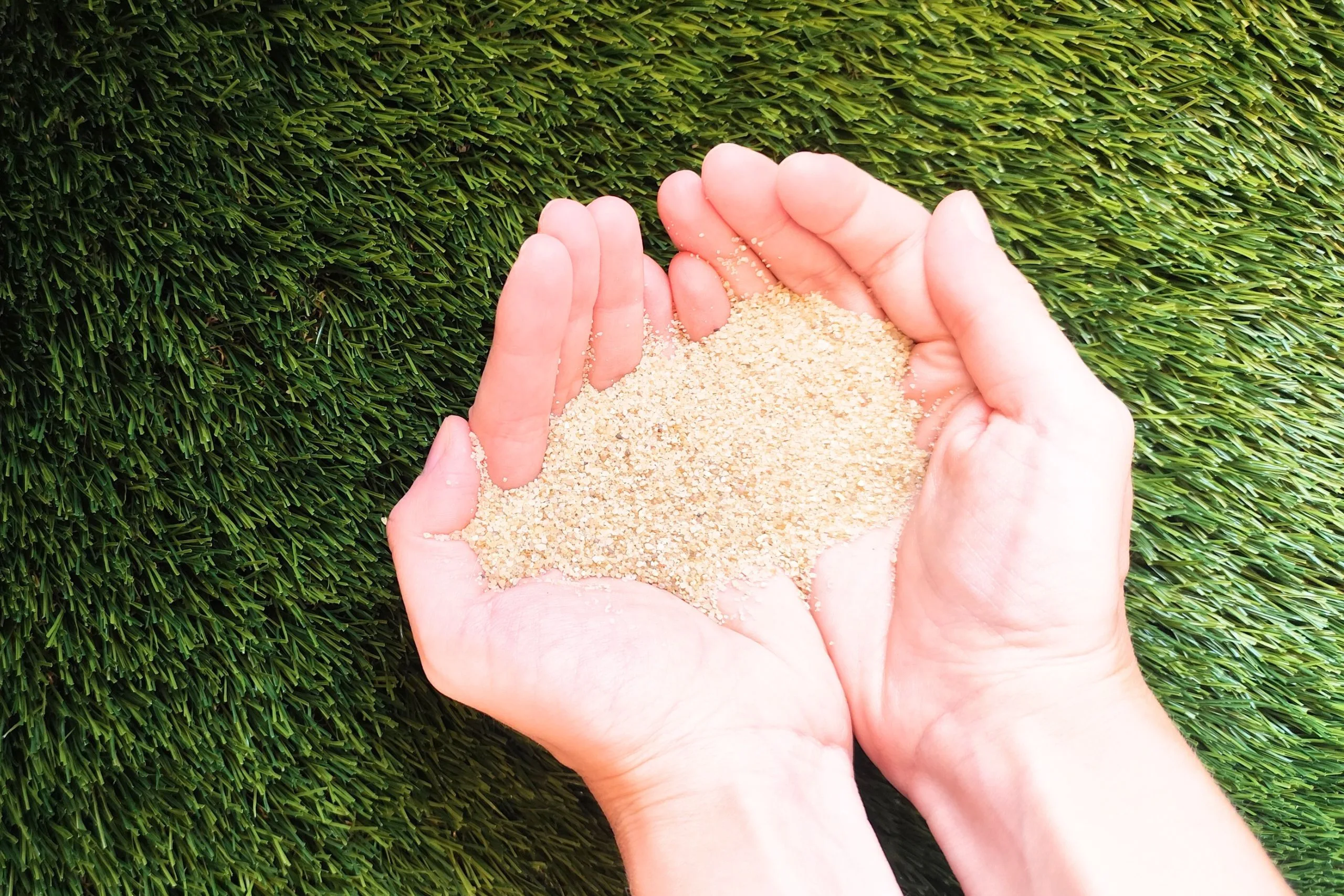
When it comes to infilling artificial turf, silica sand is the most commonly used material. It is a very fine type of sand that has been oven-dried to remove its moisture. It is composed primarily of quartz crystals.
Its main qualities are chemical resistance, uniform structure , and the ability to withstand high temperatures. Thanks to these properties, it has a wide variety of applications in all types of industries. For example, it is used in the manufacture of glass and ceramics, the filtration of drinking water and swimming pools, and the production of solar panels.
What is the purpose of silica sand in artificial turf?
As we mentioned at the beginning of this article, at jardinvertical.es we recommend using silica sand for artificial turf, especially in gardens, businesses, and pool areas. We'll detail the benefits below.
Stability and support
The silica sand infill increases the weight of the artificial grass roll, making it harder for it to shift or move. This ensures it stays firmly in place . Furthermore, it creates a more stable surface and prevents wrinkles or creases from forming with use.
Reduced wear
The infill protects your artificial grass from foot traffic and the placement of garden furniture. It helps it recover from wear and tear and increases its long-term durability
Improved drainage
Silica sand acts as a filter, regulating and slowing the water flow to ensure gradual drainage and allow the soil to absorb all the water. It also filters out leaves and branches, preventing them from entering the drainage holes and causing blockages.
Comfort
Thanks to the filling, the surface is softer and more plush. Perfect for walking barefoot or lying on the grass to enjoy a sunny day.
Static electricity
Artificial grass can sometimes accumulate static electricity due to the materials it's made from. This is an unpleasant phenomenon, especially for children, which you can solve with silica sand. This material absorbs and dissipates the static electricity generated by friction during use.
Verticality
Newly installed and brushed artificial grass looks pristine. However, over time, with use and weather conditions, the fibers begin to lie flat.
There are qualities in artificial grass models that greatly aid fiber recovery, such as the filament finish or the number of textured fibers. However, a solution for all types of synthetic grass is infill with silica sand. This ensures that the fibers return to their upright position with minimal effort, enhancing the surface's appearance.
Control the temperature
Silica sand is a perfect thermal insulator against both cold and heat.
During the summer, prolonged exposure to the sun and high temperatures can cause artificial grass to overheat. To reduce the temperature, it is recommended to water it lightly. If it has a silica sand infill, this moisture will remain in the grass longer, prolonging the feeling of coolness .
Artificial turf also tends to expand in warm weather and contract in cold weather. With the right infill, these movements are minimized thanks to temperature control and the weight it exerts on the surface.
Fire resistance
An additional benefit of the infill, which isn't often mentioned, is that it improves the fire resistance of your artificial grass. This is because sand is non-combustible and therefore reduces the effect of flames on the turf.
How to apply silica sand
The process of topdressing with silica sand is very simple.
- First, make sure your surface is clean. Remove any leaves, twigs, or other debris or dirt.
- Begin spreading the sand as evenly as possible. If you have one, you can use a garden spreader.
- Once you've spread all the sand, you'll need to brush the artificial turf so it seeps into the fibers. You can do this with a rake or a stiff-bristled brush, against the grain. Use short, quick strokes to help the sand penetrate. For best results, the sand should be barely visible.
Water the surface so that both the grass and the sand settle properly.
What quantity of silica sand is recommended depending on the use?
The recommended amount of silica sand varies depending on the type of terrain and the intended use of the surface. Generally, for decorative artificial grass applications such as gardens, patios, or terraces, approximately 5 kg per square meter is recommended . This would mean that for a 40 mm pile height, a 1 cm layer of infill would be required, and for a 60 mm pile height, a 1.5 mm layer.
If the area has a lot of traffic, such as the garden entrance, it may be necessary to add 1 or 2 kg more per square meter every year or year and a half.
For sports use , such as a football field, it is recommended to use about 9 kg per square meter.
These are the recommended amounts to achieve a durable artificial grass that is pleasant to walk on and well attached to the ground.
What is the ideal silica sand for artificial turf?
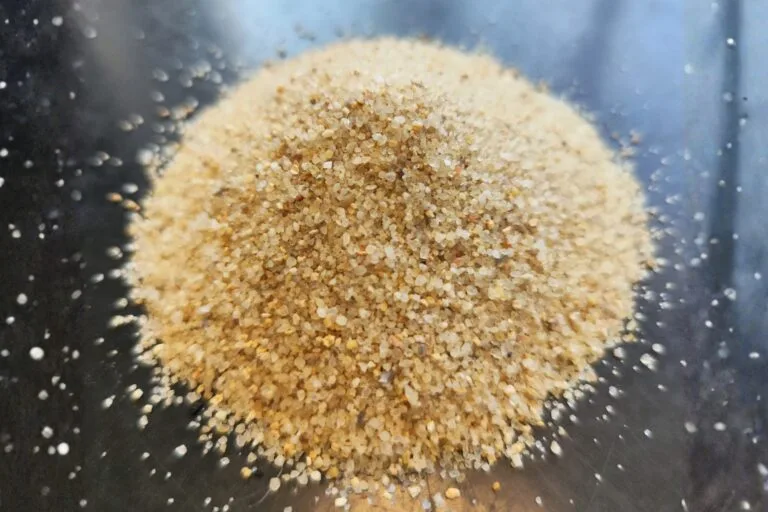
As we have seen previously, silica sand is made up of quartz crystals. The size varies between 0.5 mm and 1 mm in diameter and it contains no impurities. Its main qualities should be:
- A purity level higher than 96%.
- It has to have a rounded.
- It must have been washed to remove all dust.
- It must have undergone a drying.
If the sand doesn't meet these characteristics, it can be detrimental to the turf. For example, if it's not rounded, its edges can damage the turf fibers through friction from foot traffic. If it hasn't been washed, the dust will compact and negatively affect the drainage of the artificial grass.
In summary, using the wrong or poor quality silica sand can cause synthetic turf to deteriorate more quickly.
Does the silica sand need to be changed? Maintenance and replacement
Silica sand doesn't need to be replaced once it's spread over your artificial turf. However, factors like foot traffic, wind, and rain cause it to be lost over time. That's why we talk more about refilling than replacing.
The recommended time to replace the silica sand depends on the use and traffic of your artificial turf. Approximately every year or year and a half, high-traffic areas will need replacing. However, areas with less traffic can last more than two years.
It will also depend on the type of fibers in the chosen artificial grass model. A model with a lot of textured fiber takes longer to lose its sand and, therefore, lasts more than two years without needing to be replaced.
In the case of children's playgrounds or sports surfaces, it is recommended to renew the filling more frequently since it also provides vital cushioning for this type of facility.
To find out if your artificial grass installation needs to have more sand added, you should look at:
- Recovery under foot traffic. If the grass blades no longer stand upright and tend to lie flat quickly.
- Movements. Artificial turf moves, forming wrinkles or ripples.
- Higher temperature. Sand acts as a thermal insulator, so areas with a higher temperature are usually an indication that that area needs more fill.
- Appearance. Generally, silica sand is not visible to the naked eye, but if you look closely and separate the fibers, you will be able to see it. If you only see the black base of the artificial grass, it clearly lacks infill.
When maintaining the infill of your synthetic turf, you will only need a stiff bristle brush to help spread the sand evenly across the surface.
Alternatives to silica filler
Silica sand is the most commonly used material for infilling artificial turf installations. However, there are other alternatives that may interest you:
- Rubber. This type of material is frequently used in sports environments because it provides good cushioning, better rebound, and greater comfort for players. For example, soccer is one of the sports that uses the most rubber in its facilities. However, due to the use of recycled rubber from products such as tires, it has been considered a potentially polluting product and is beginning to be replaced by more natural alternatives.
- Coconut fiber. This natural material is biodegradable and has the capacity to absorb a large amount of water. Therefore, it is an excellent alternative for environments with high humidity. On the other hand, it is a more volatile material, so its durability is lower and it will need to be replaced more frequently. Its brown color also adds to the natural appearance of artificial turf.
Currently, research continues into natural alternatives such as ground olive pits, cork granules, marble dust, crushed wood, corn cobs…
In conclusion, silica sand is currently the most widely used infill for artificial turf. This is because its advantages are significantly superior to other options. Furthermore, the benefits it provides are so numerous that it's impossible not to recommend using silica sand infill for your artificial turf.
Hello,
I wanted to know if you install infill sand for small sand soccer fields. In our neighborhood, we have a small sand soccer field (20m x 7m) and we want to refill and level it.
We are located in the Hortaleza district of Madrid. Thank you very much, Jacvier
We're sorry, but we don't install artificial turf or sand infill. Best regards.