


Approximate reading time: 2 minutes, 54 seconds
Installing artificial grass on a concrete or cement surface is one of the easiest to do. Mainly, because the land is already prepared and leveled, ready for laying the synthetic grass .
If your garden is made of dirt or with natural grass, we recommend that you take a look at our article: “ How to install artificial grass on dirt: 7 Steps ”
If you are thinking about installing artificial grass yourself in your house or terrace with concrete, you cannot miss the following article on our blog.
Materials and tools needed for installation
- Quality Artificial Grass
- Cutter.
- Meter and ruler.
- Self-adhesive joint strip (option 1)
- Joining band and glue for artificial grass (option 2)
- Silica sand (optional)
Installation of artificial grass on concrete or cement
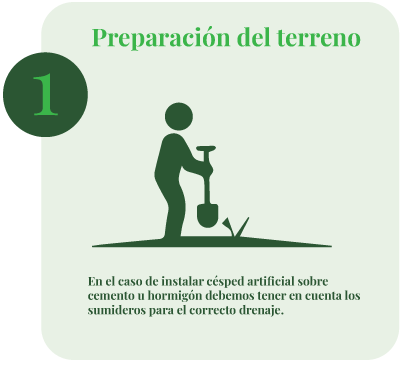
1. Preparation of the land on which to place the artificial grass
The main advantage of installing artificial grass on concrete or cement is that the ground is already prepared . The surface is smooth, there are no weeds and the ground is already level.
The only thing we must take into account is the sump or drain, so that when the synthetic grass is watered or it rains, it can drain correctly . In this case, the drain area can be cut out or cut in a U shape (as if it were a cover) to lift it in case of heavy rain.
2. Place the artificial grass on the cement
It is important that we have correctly taken the measurements of the surface that we want to cover with the artificial tapestry. If you have a complicated garden shape, we recommend taking a look at our article “ Custom Artificial Grass: How many square meters do I need?” ”
To place the rolls of synthetic grass, it is important that we take into account the direction of the filaments. All the cloths should be placed in the same direction to achieve an optimal and very natural . For this reason, we recommend, when purchasing artificial grass , to do the calculations with 10% more material . The remains left from the cuts will probably not be usable in other areas.
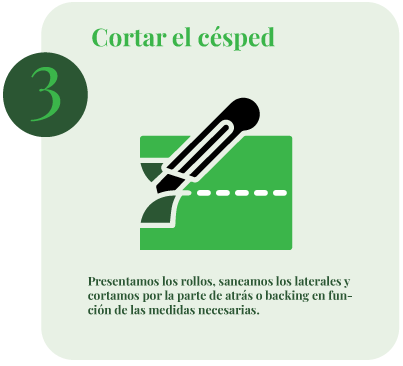
3. Cut the artificial grass rolls
Once we have all this prepared, it is time to spread the 2 meter wide . We mark the cuts that we must make and with the help of a cutter and a ruler we always make the cut from the back or backing .
the final part of the artificial carpet must be to achieve a good result. This step is very important, so it is better to do it slowly and following a straight surface so as not to cut too much and end up crooked.
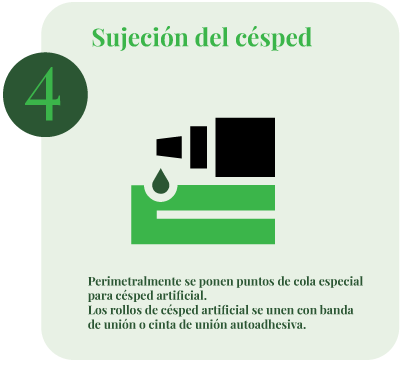
4. Fixing the artificial grass on the concrete or cement
To stick the artificial grass cloths together we can use self-adhesive joining band or joining band with special glue for artificial grass . half a centimeter of separation between the rolls of grass so that the joint between the two is not visible to the naked eye. Once we have this prepared, it is time to place the joining band.
If you choose a self-adhesive joining strip, slowly remove the protective paper and gradually stick the artificial grass cloths. If you choose the single-joint band option, place it between both rolls. Lift its corners and pour the glue over the band. The last step would be to glue each of the artificial grass rolls with their corresponding separation.
On the perimeter you can put some glue dots so that the artificial grass blanket does not move. Remember that it is not necessary to glue the entire surface, just the perimeter .
5. Repriming with silica sand and finishing touches
The last steps to finish installing artificial grass are to comb the synthetic grass against the grain to lift its filaments and add silica sand . Although the latter is optional, we do recommend it when it comes to artificial grass over 30 mm high so that it has good recovery when stepped on.
Artificial grass for the whole family
Installing synthetic grass on cement or concrete on your terrace or patio is very simple if you have the necessary materials for it. The result will be spectacular and the whole family will be able to enjoy a pleasant soft and fluffy surface . Both children and pets will greatly enjoy playing on this surface.
On our website you can find all the materials you need to create a cozy space with quality artificial grass in rolls or by cutting .
